This July, Singapore cinemas added 70 extra Teochew-language screenings of Dear You (给阿嬷的情书) to meet demand. The surprise hit is built around qiaopi, the letters overseas Chinese once sent home with money inside.
For about 150 years, migrants across Southeast Asia wrote home this way: a few dollars folded into a few lines of news. Many of the writers were Teochew, sending their savings from Singapore to families in Chaoshan, the Teochew heartland in eastern Guangdong.
Today those letters are part of UNESCO’s Memory of the World. And with a little help from AI, you can write one yourself.
A letter with money inside
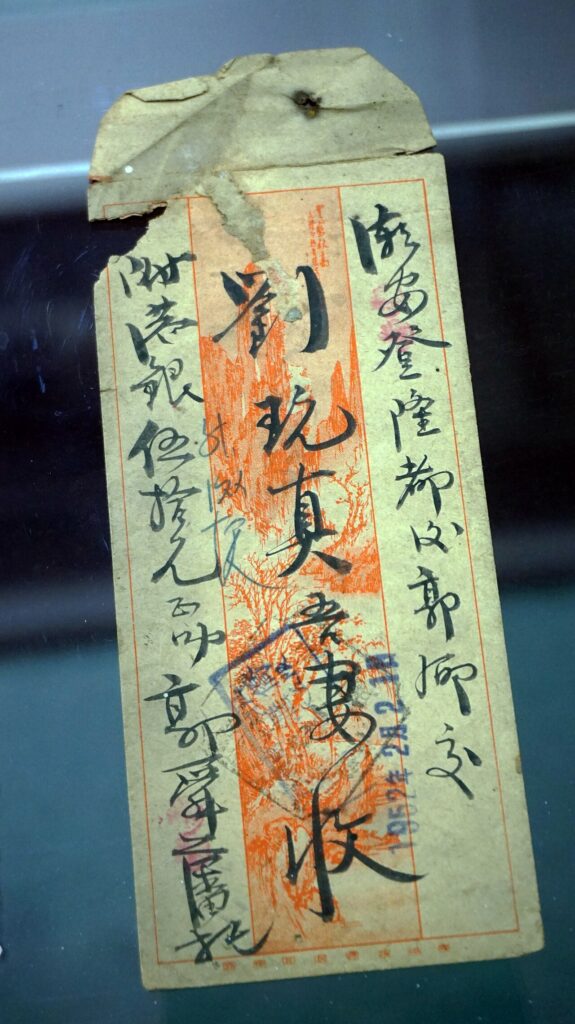
A qiaopi (侨批) is a family letter and a remittance sent together. Qiao means overseas Chinese, and pi is the Hokkien and Teochew word for a letter. They were also called yinxin (银信), or “silver letters”.
The envelope stated how much money was inside. Once it arrived, the family sent back a huipi (回批): a reply confirming receipt and carrying news from home. Not every qiaopi held cash — a letter without money sometimes brought word of a death.
Many migrants could not read or write, so they paid someone who could. In Singapore, letter-writers set up a small table with brush and ink in a shophouse five-foot way or under a tree. They charged three to six cents a letter, depending on its length.
Couriers, monsoons and remittance houses
The first carriers were shuike (水客), or “water guests”: traders and returning migrants who carried letters and cash by hand. By 1849, Singapore alone had about 200 of them. Ships sailed with the monsoon, reaching Singapore on the northeast winds in December and heading home on the southwest winds in June.
A delivery could take months, and couriers charged as much as 10 to 20 per cent of the sum. The system ran on trust: a courier who lost or kept the money shamed his whole clan. But as the trade grew, so did the cheating.
Shops stepped in. Bakeries, medicine halls, printers and tea merchants handled remittances on the side, and from the 1830s merchants set up dedicated remittance houses, or qiaopiju (侨批局).
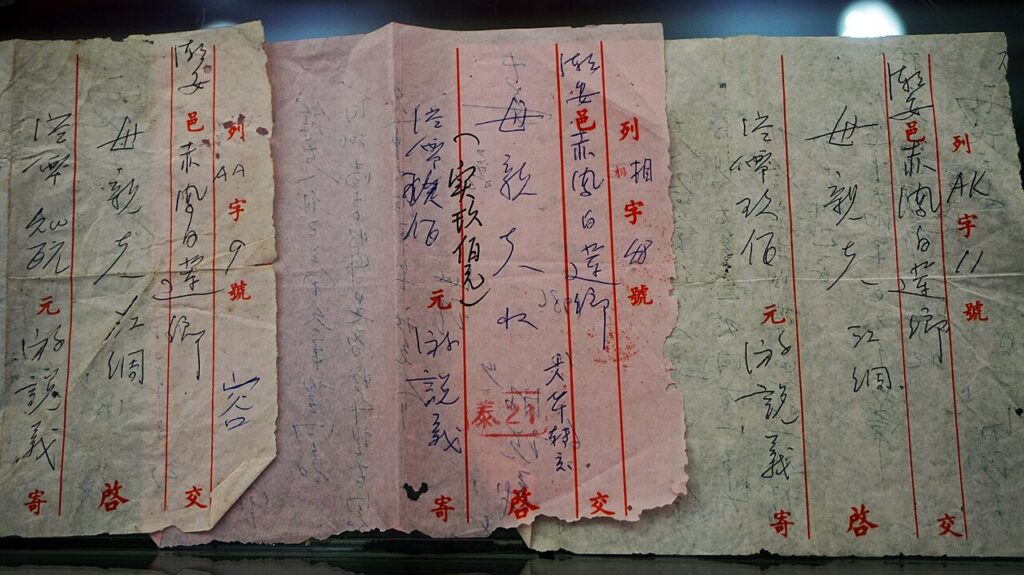
By the 20th century, the process looked much like a modern money transfer. The sender paid in local currency, got a receipt with a serial number, and handed over the letter. The firm wired the money to its branch in a port such as Shantou or Xiamen, and posted the letter separately.
Staff there delivered cash and letter together, reaching villages the post office could not. A small reply slip came attached to the back of each envelope.
Singapore, the hub
Singapore sat at the centre of the network. Letters and money from across Southeast Asia gathered in its remittance houses before going on to Hong Kong and China. In the late 1940s, the island handled nearly 18 per cent of the whole trade.
The business ran along dialect lines, with Teochew firms in the lead. In 1887, Singapore had 49 remittance houses: 34 Teochew, 12 Hokkien, two Hakka and one Cantonese, with Hainanese firms following soon after. Their number peaked at about 200 in the late 1940s (Liu and Zhang, 2020).
The letters bear this out. Of 32,317 original qiaopi held by the Museum of Chaoshan Qiaopi Archives in Shantou, 37 per cent were sent from Singapore.
The colonial government tried to take the business over. To protect migrants from couriers who vanished with their savings, it opened a Chinese Sub-Post Office on 15 December 1876. Placards blamed on remittance-house owners claimed it would be compulsory and costly.
Rioting broke out on opening day, and three people died when police opened fire. The office reopened three days later and merged into the General Post Office in 1877 (Infopedia). The private firms carried on, trusted by customers and quicker with the small sums most migrants sent.
What the letters say
Most qiaopi are short and formal. They open with respectful greetings, ask after parents’ health, and say what the money is for: household costs, a child’s schooling, offerings to the ancestors. In Teochew homes, those offerings still call for a plate of kueh.
Some arrived with goods that were scarce at home, such as flour, Western medicines and new fabrics. Many carry the writer’s dialect too, with Teochew, Hokkien, Cantonese, Hakka or Hainanese words set down on paper.
Between the set phrases is real life: family affairs, work, prices, politics and war. UNESCO values the letters as first-hand records of migrants’ lives, and as a rich supplement to official histories.
War, and the end of an era
War broke the network. When Japan occupied Hong Kong and Singapore in 1941–42, the main route between them closed. Remittance houses found a detour through Móng Cái in northern Vietnam to Dongxing, just across the border in Guangxi.
Couriers carrying money by hand became vital again. After the war, the old Singapore–Hong Kong route soon returned.
But the world that needed qiaopi was fading. Emigration from China fell sharply after 1949, and a generation born in Singapore and Malaya put down local roots. Banks made transfers simple, and by 1970 Singapore’s remittance houses had dwindled to about 60.
China’s central bank, the People’s Bank of China, took control of the trade in 1973. In 1979, the people still running it were absorbed into state-owned banks, and the qiaopi era was over.
From family letters to world heritage
More than 160,000 qiaopi have been collected and preserved in Guangdong and Fujian. They joined UNESCO’s Memory of the World Register for Asia and the Pacific in 2012, and the international register in 2013.
Shantou’s Museum of Chaoshan Qiaopi Archives is the earliest and largest archive devoted to them. Online, the Singapore Chinese Cultural Centre’s Culturepaedia is a good first stop.
If your family still has qiaopi, keep them flat, dry and out of direct light, and scan both letter and envelope. Then ask older relatives who wrote them, and when. That story is worth saving too.
Write your own qiaopi
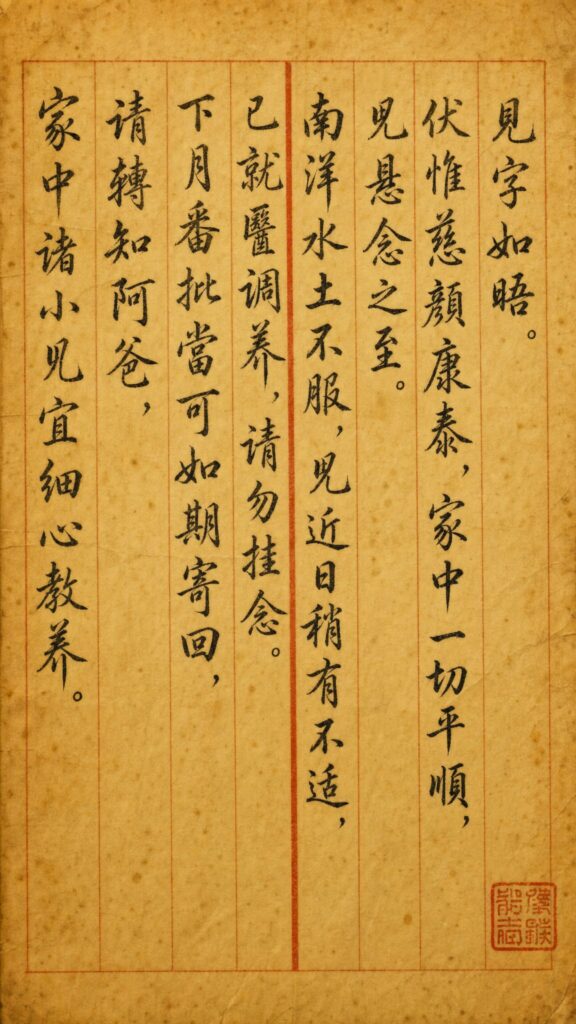
If the film left you wondering what you would write, try the AI Qiaopi Generator. It has a Chinese site at ai-qiaopi.com and an English version. You can write in either language, and the letter comes back in Chinese brush calligraphy.
- Write what you want to say, up to 500 characters, in everyday Chinese or English.
- Add the sender and recipient, and pick the relationship: mother, grandparents, a friend and so on.
- The AI rewrites your words in qiaopi style, semi-classical with honorifics and traditional closings. You get ten seconds to edit.
- The site renders the letter on red-ruled paper with a seal and an aged texture. Download the image or share a link; your letters are also saved in your browser.
A developer inspired by Dear You built the site, and presents it as a way in for ordinary people rather than a research tool. Treat what it makes as a tribute, not a replica. Check the characters before you print or share: the site’s own FAQ explains why the image may not match your text exactly.
Some ideas: write to a grandparent who made the crossing, send one at Qingming or Chinese New Year, or print it beside a real family letter.
From our kitchen
Qiaopi survive because families chose to keep them. We started this kitchen for a similar reason: to keep Teochew kueh alive, and to give women rebuilding their lives somewhere steady to work.
We still make every kueh by hand each morning, the way the recipes were taught to us. If you’re visiting the grandparents soon, bring a box of their favourites — collect from our kitchen in Joo Seng, or have it delivered islandwide. Order kueh →